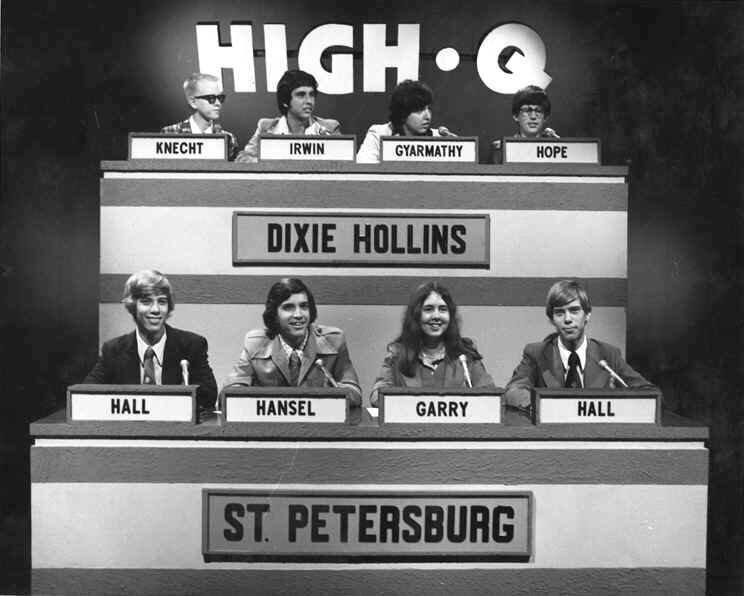
High-Q was one of several weekly programs
recorded on video tape
Rewinding the Past
Restoration of WTVT Video Tapes
by Mike Clark
|
|
First the bad news: Very little video tape remains of WTVT's fifty-year history.
Now, some good news: Along with a limited number of kinescopes and photographs, a small collection of WTVT video tapes are being preserved to allow us a look into the station's past.
When home video became available in 1976, some employees were able to record local WTVT programming on Betamax or VHS. Prior to that time, the only way to have a permanent video was to receive a Umatic (3/4" tape size) video that played on an industrial machine. Most television stations owned Umatic recorder/players, but they were expensive, heavy, and somewhat large compared to later home video machines.
Videos provided to employees to be used as a keepsake or for audition purposes usually consisted of a small reel (about 8 inches in diameter) of 'quad' tape (see photo above). The length of such a reel varied from 5 minutes to 15 minutes on average. But without access to a broadcast video tape player, the reels could not be viewed. After thirty-plus years, these reels are in a delicate state. Before any additional deterioration occurs, tapes like these should be dubbed to a current tape or digital format for preservation.
BIG 13 has been able to gain access to some of these materials for the purposes of duplication and preservation. Before we explain the process, a little background
LIVE ON TAPE
Most of WTVT's local programming was live. Mary Ellen, 3-D Danny, Pulse News, and Ernie Lee's various morning programs went out over the air and into history. Occasionally, a recording was made and referred to as an air-check. Its purpose was for the on-air people and crew to look back at their efforts and evaluate a program's effectiveness. Air-checks were seldom stored for historical valuethe tape was reused for other purposes mainly due to the costabout $150 for a half-hour reel (in 1960s/1970s dollars).
High-Q was one of several weekly programs
recorded on video tape
When certain programs were recorded in advance, such as "High-Q", "Shock Theatre," "College Kaleidoscope," or "Black Contact," the same reel of tape was used week-to-week, erasing the previous program.
WTVT's storage warehouse was in the rear parking lot facing North A street. Many reels of tape were kept there until the order came down from management to clear the area and dispose of the tapes. Unfortunately, most of the materials were trashed with no effort towards preserving certain historic reels or creating select reels from the originals. Who knows what broadcasting history went into the dumpster? It's sad, but not unusual in the television industry.
RAPID OXIDATION
Video tape of the era was 2" wide and referred to as "Quad" tape, named after the Quadraplex recording head in the video tape recorder (VTR). Manufactured by the 3M Company, Ampex, RCA, and others, the tape was basically a thin layer of plastic base coated with magnetic oxide (commonly called "rust"!). Over a period of time, quad tapes have been known to flake, which will clog the head of a VTR, or become sticky, which gums up the machine's guides and causes the playback to cease. These problems can occur even if the tape was properly stored in a temperature and humidity controlled vault. More often than not, the air-checks saved by former employees were stored in closets or attics, and subject to varying temperatures and humidity which can make playback and preservation a challenge.
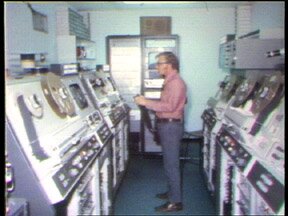
Duane Martin in WTVT's tape room
VTRs of the time were huge, noisy machines that required an enormous of power and air conditioning. If properly maintained, their picture quality was very good, 525 lines of horizontal resolution playing 30 frames per second. Most quad machines went the way of the dinosaur in the early 1980s, as newer video tape formats became the standard. Today, only a handful of facilities in the United States are equipped with quad machines for the purpose of archiving.